
When foodservice concepts are planned, the display case is often treated as a single building block. In reality, though, it’s the interaction of preparation, storage, presentation, and replenishment that determines how long food stays appealing, safe, and sellable.
This article shows why quality isn’t decided at the display case, and which requirements should therefore be factored into the planning from the very start.
Table of contents
- Daily flexibility — geared to customer needs
- What does holding time mean for ready-to-eat food?
- The real problem often starts before the display case
- Why this topic is becoming more important
- What happens during off-peak hours?
- 4 elements that matter in planning
- Two perspectives on the same display case
- Where technology makes the process possible
- Planning checklist
- Watch the full webinar
- Conclusion
Daily flexibility — geared to customer needs
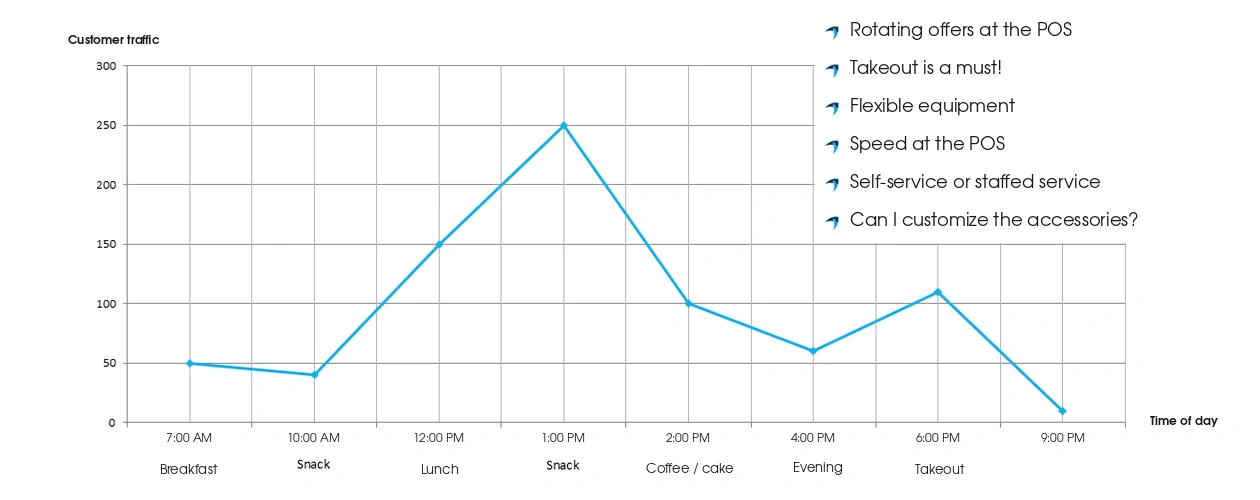
Just after 3 p.m.: the lunch rush is long over. Only a few products are left in the display case, spread across a large presentation area. What looked appetizing and abundant during peak hours now gives a different impression. Anyone passing by at this point doesn’t reach for anything. That’s not down to the product itself, but to the fact that it no longer looks appetizing — and hardly anyone wants to take the last piece from a half-empty display.
Moments like these cost revenue. Falling purchase impulses on one side; write-offs and food waste on the other. Both can often be traced back to the same origin: a process that isn’t consistently aligned with the actual demands of day-to-day business.
To understand this connection, it’s worth taking a closer look at the term everything revolves around.
What does holding time mean for ready-to-eat food?
In foodservice, holding time refers to the period during which ready-to-eat food may be kept available after preparation without any loss of quality or hygiene, before it has to be served or discarded. That makes it far more than a question of appearance, because the longer the duration, the higher the risk of microbial growth.
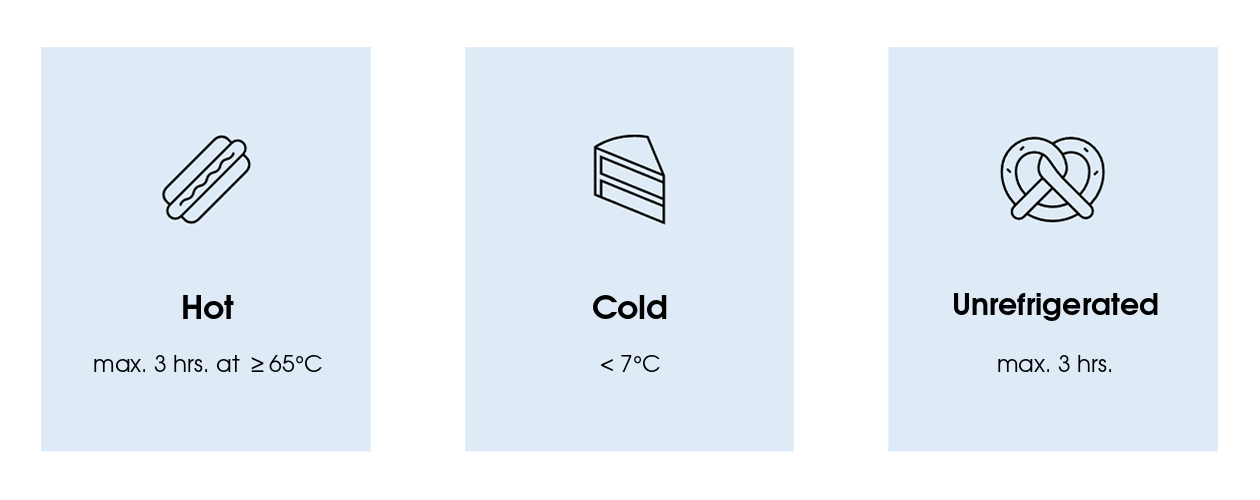
HACCP concepts set clear limits for this. Cold food belongs below 7 °C (45 °F), hot food should be held at a minimum of 65 °C (149 °F), and neither should remain there for longer than three hours. The same applies to unrefrigerated ready-to-eat goods. Every plan operates within this framework. Anyone who wants to extend holding time without exceeding these limits therefore has to start with the process, not the temperature. And that process begins earlier than you might think at first glance.
The real problem often starts before the display case
When quality drops off in the afternoon, the display case is usually the first thing to come under scrutiny. Too warm, too cold, or too dry. In many cases, though, it’s merely the place where a problem becomes visible that arose considerably earlier.
Anyone with a kitchen background knows the subject of holding time all too well. The aim always stays the same: to serve the guest the best possible quality. What’s often underestimated, however, is that this aim isn’t decided at the display case alone, but across the entire process leading up to it.
Because food changes over time — whether kept warm, refrigerated, or in a neutral zone. This process can’t be stopped, only slowed. And the decisive lever isn’t the presentation area alone, but everything that happens before it:
- How are products prepared and held in interim storage?
- How quickly can smaller quantities be produced on demand?
- How short are the distances between kitchen, storage, and service point?
- How often is stock replenished?
Anyone planning a display case without factoring in this workflow is planning around the actual root cause.
The heat chain is a term that’s rarely mentioned but explains a great deal. Everyone knows the cold chain, yet the fact that the same principle applies to holding food warm is easily overlooked. Every transfer, repackaging, or brief interim placement means a loss of temperature. The assumption that the display case will make up for it is a fallacy. A heated display case is built to hold temperature — not to reheat products that have cooled down. If it’s used for that anyway, the temperature often has to be set unnecessarily high. That can cause products to dry out, change consistency, or lose their appeal.
Why this topic is becoming more important
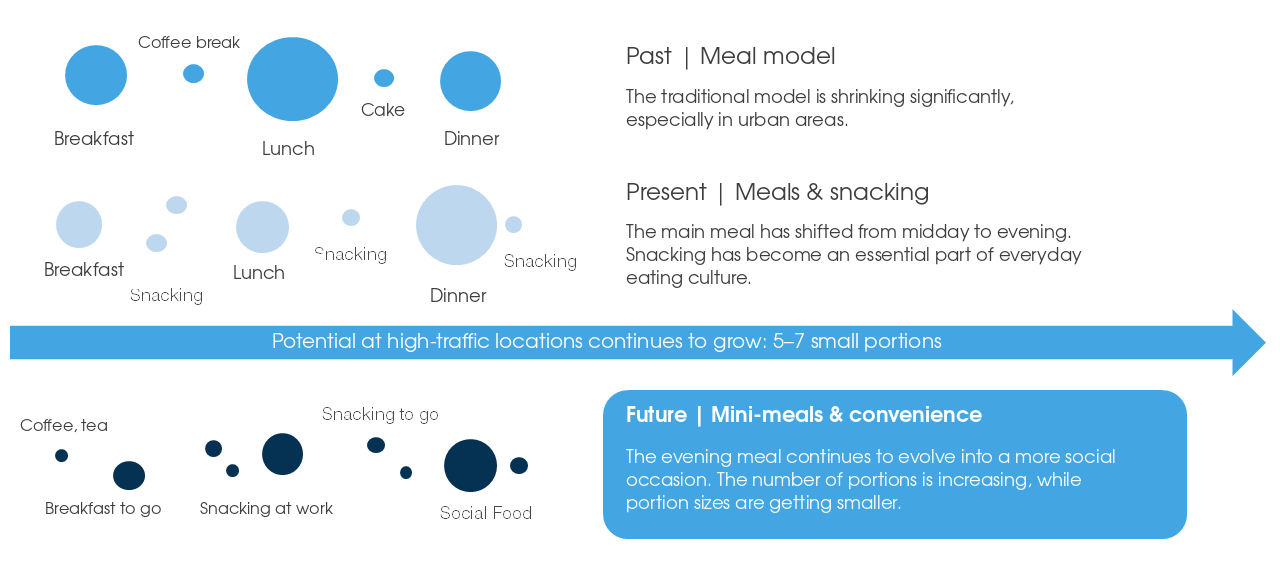
There’s a reason this process has to be thought through so carefully today: eating habits have been changing fundamentally for some years now. The classic model of three fixed meals a day is shrinking noticeably, especially in urban centers. In its place comes a food culture in which snacking has become a fixed component and the main meal has moved from midday to the evening. The trend keeps moving toward many small portions spread across the day, rather than a few large ones.
For foodservice, that means more service points throughout the day, smaller quantities per transaction, and changing offerings over the course of the day. A concept designed solely around a large lunchtime peak quickly reaches its limits under these conditions. What’s needed are solutions that make it possible to present smaller quantities freshly, flexibly, and economically. Whether a concept meets these requirements, however, shows not during the lunchtime peak but in the quiet hours afterward.
What happens during off-peak hours?
During peak times, almost any concept works. Product turnover is high and fast, and the goods barely sit long enough to lose quality. The honest test only comes afterward, from around 2 p.m.
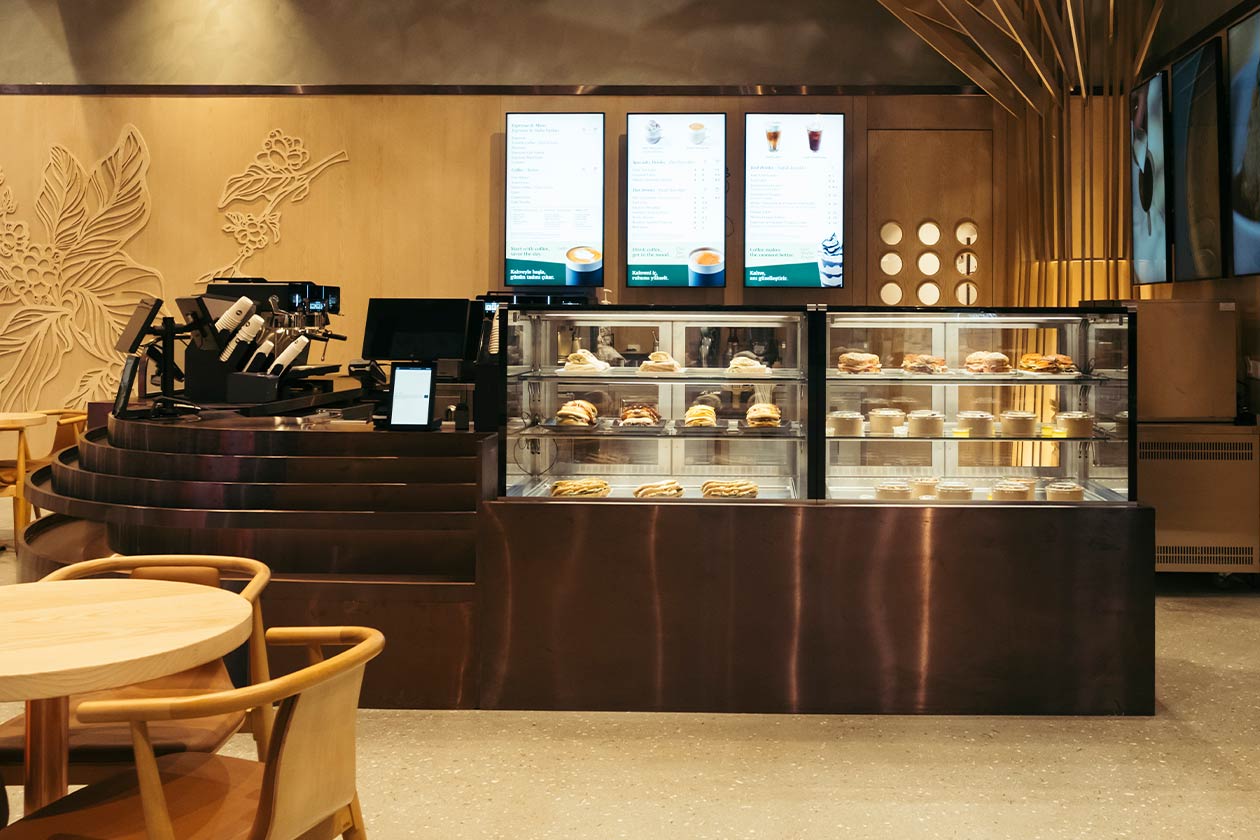
Now it becomes clear whether a concept is truly well thought out. A large-area display can boost sales during peak times, yet do the opposite during off-peak hours. A few products get lost on too large a surface and quickly give the impression of a range that’s winding down.
The solution isn’t to provide more goods. What matters instead is adapting the presentation to actual demand. This is exactly where the principle of rolling freshness comes in: rather than keeping large quantities available over long periods, smaller batches are presented and replenished at short intervals. Ideally, the resupply comes straight from warm or refrigerated storage close by. That keeps the display appealing throughout the entire day, while products spend less time on presentation. The central question is therefore no longer: “How long may a product stay in the display case?” but rather: “How do we manage to present freshly all day long?”
For that to work, you need planning in which workflow, workspace, and technology consistently work together.
4 elements that matter in planning
If the process determines quality, then the technology has to make that process possible too. For everyday foodservice, that means one thing above all: staff shouldn’t have to leave their position during peak times in order to maintain the workflow defined beforehand.
Everything needed for preparation, on-demand production, storage, and presentation should be within immediate reach. Much like mise en place in the kitchen, this creates a workspace designed for efficiency, quality, and short distances.
Four elements are decisive here, and they can be applied to almost any plan regardless of the specific concept:
1.
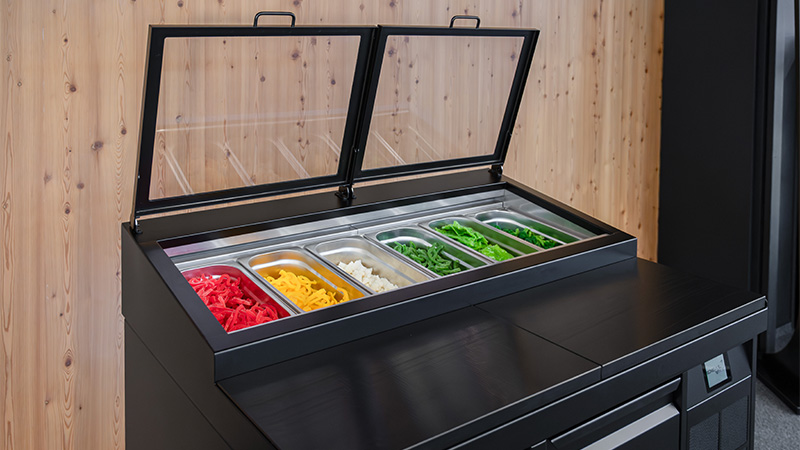
A place to prepare and produce on demand that makes smaller batches possible, instead of forcing a single large pre-production run.
2.
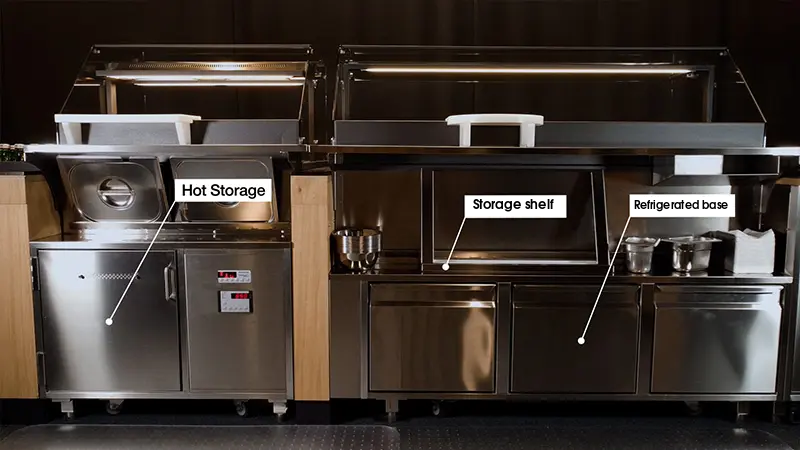
Interim storage right at the point of sale — warm or cold depending on the concept — so that distances stay short and the temperature chain isn’t interrupted unnecessarily.
3.
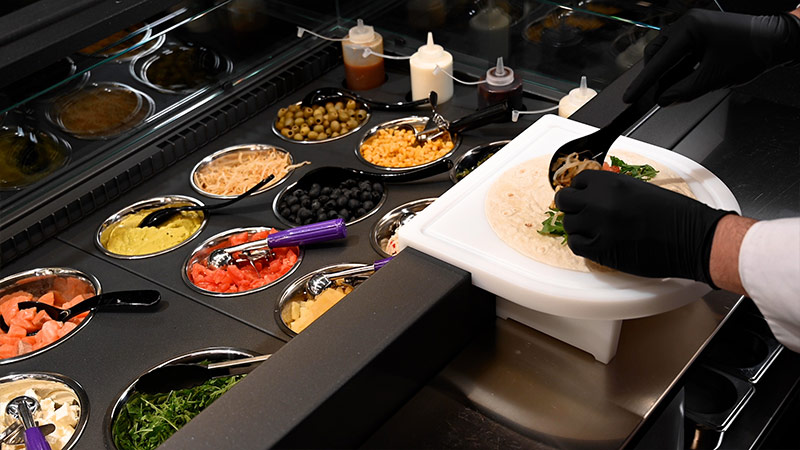
A compact work area at the display case where components can be finished right in front of the guest. Classic front cooking thus becomes front finishing, where the final touch happens visibly in front of the guest. That not only preserves freshness but makes it tangible — and increases added value at the same time.
4.
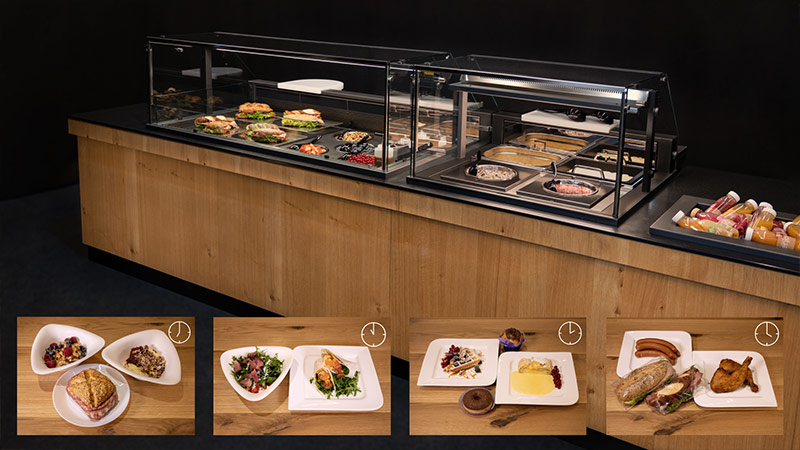
An adaptable presentation area that can be geared to daily demand instead of being rigidly designed for the lunchtime peak.
This keeps the presentation complete and appealing without providing unnecessarily large quantities.
Alongside these four elements, climate control and packaging also play a central role. Starchy and protein-rich products place different demands on temperature and humidity. With precisely controllable humidification, product quality can be maintained over a longer period.
And anywhere forced-air heat is used — such as in grab-and-go areas — the right packaging determines how well the holding time can be put to use. Crispy baked goods, for example, benefit from perforated packaging that lets moisture escape. Moisture-sensitive products, by contrast, tend to need closed packaging so they don’t dry out.
The same idea is always at the center: it’s not about artificially extending holding time. It’s about reliably preserving quality within that time.
Two perspectives on the same display case
However well thought out the workflow is, in planning two perspectives ultimately meet, both of which have their merits.
From the customer’s point of view, what counts above all is what’s meant to be sold. This includes product presentation, the choice between self-service and assisted service, and the customer’s own concept with the workflow behind it.
From the manufacturer’s point of view, the technical factors move to the foreground — the ones that determine whether all requirements are met. These include product temperature and humidity, among others. Equally important is the question of the right cooling or heat retention: forced air or static cooling, dry heat, forced-air heat, or heating climate. And not least, whether a unit should be self-contained or centrally cooled.
A good concept emerges where both perspectives come together. Because in the end, a display case shouldn’t store — it should sell. It turns from a mere product carrier into a silent salesperson, but only when the technical basis matches the intended sales concept. This is exactly where early coordination between planner and manufacturer pays off.
Where technology makes the process possible
These are precisely the requirements we develop our units for at IDEAL AKE.
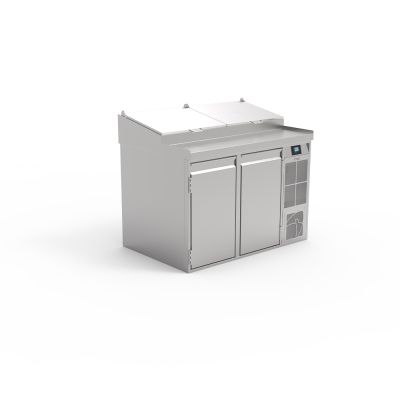
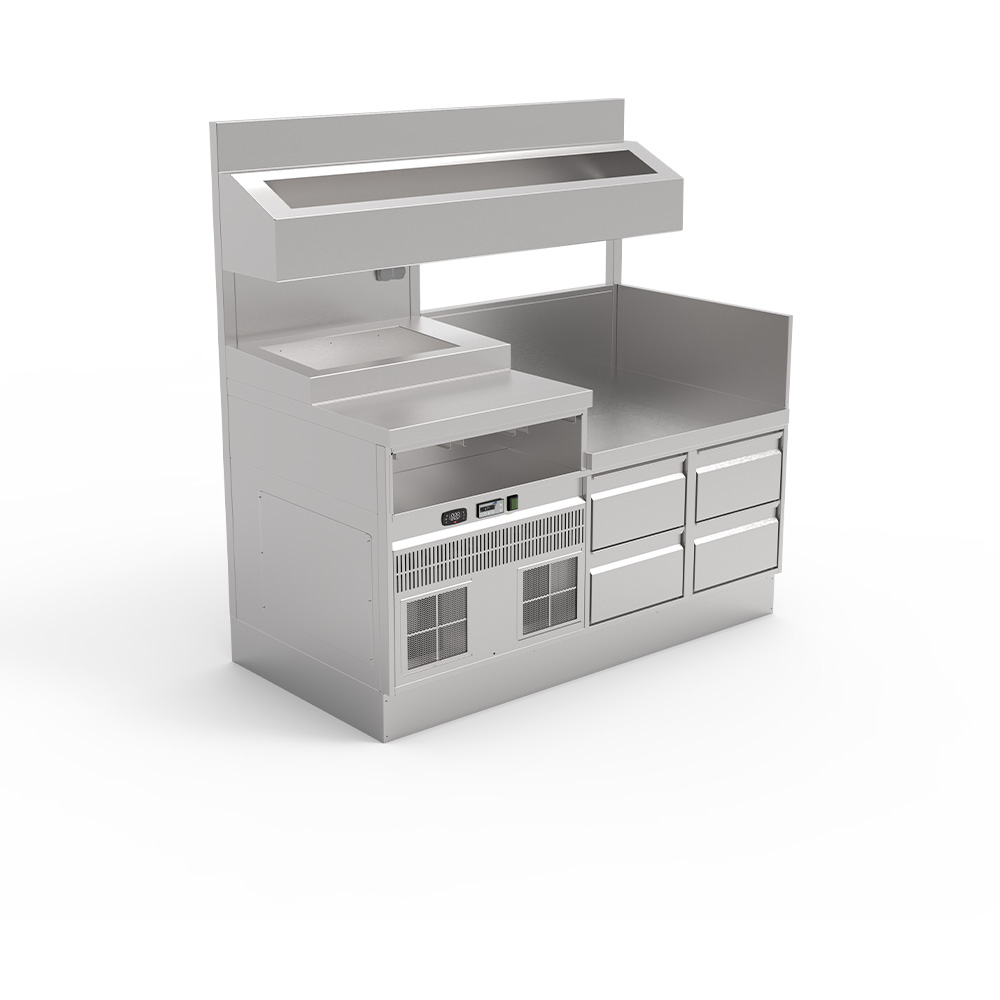
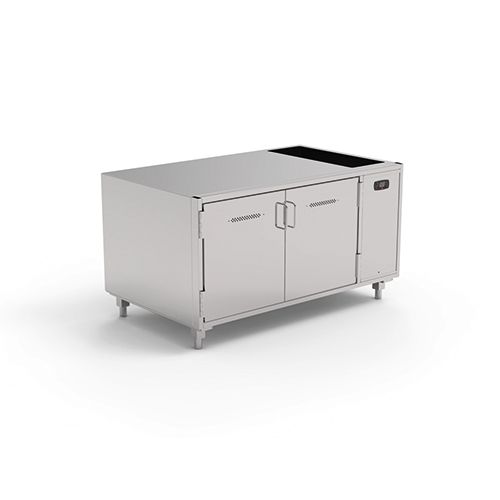
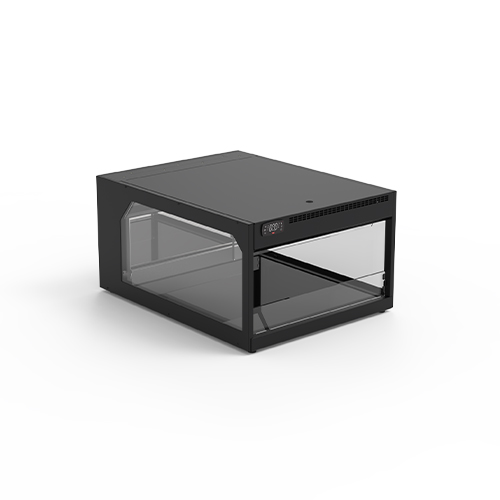
The forced-air food preparation stations keep prepared components reliably cold while providing a work surface for preparation and on-demand production. The Make-Art tables, in turn, are an answer to compact-footprint concepts and can be configured either with cold storage in the base or as a warm version with Hot Storage.
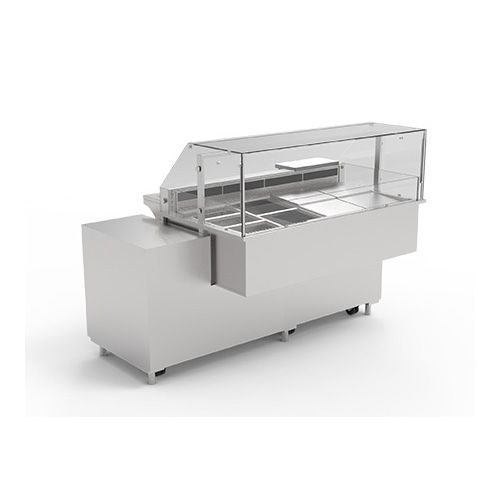
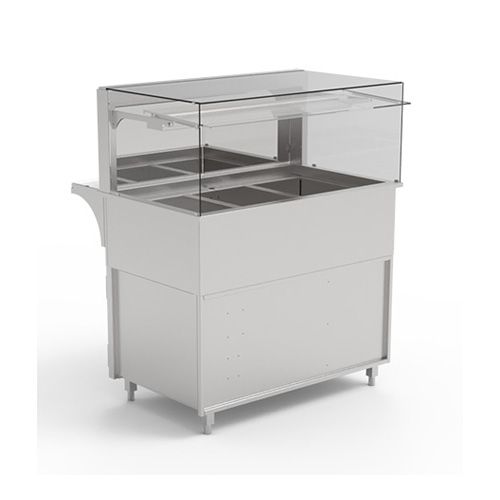
The Vario Food Counter combines warm, cold, and neutral presentation in a single unit. Using accessories such as insert frames, it can be switched from a GN to a bowl display in just a few moves, making rolling freshness thoroughly practical. Warm storage in the base is handled by Hot Storage, while the Hot Vario uses forced-air heat to serve packaged products in the grab-and-go area. And anywhere the degree-precise control of heat and humidity matters, our display cases with heating climate come into play.
The decisive factor is never the individual unit. Quality comes from the interplay of all components: from preparation through storage and climate control to presentation at the point of sale.
Planning checklist
Anyone planning a concept, or reviewing an existing one, can use these questions as a guide:
- Is there a place to prepare and produce on demand planned right at the point of sale?
- Is there interim storage (warm or cold) close enough to the display case to keep distances short?
- Can the presentation area be adapted to the course of the day, or is it rigidly designed for peak times?
- Is the concept built around many small portions throughout the day, not just the one lunchtime peak?
- Is climate control matched to the actual products (static, forced air, heating climate)?
- Are the HACCP limits (cold below 7 °C / 45 °F, hot at least 65 °C / 149 °F) reliably maintained in ongoing operation?
- Are the heat and cold chains interrupted as little as possible?
- Does the packaging suit the unit, especially with forced-air heat?
- Is the display case designed for rolling freshness, with storage in the base?
- Does the technical basis of the display case match the intended sales concept?
Watch the full webinar (DE)
This article sums up the key ideas, but much of it is best understood at the units themselves. In the webinar, Andi Schäfer and Patrick Köberl show directly in the showroom how the individual concepts mesh together — from rolling freshness through front finishing to choosing the right unit. If you’d like to see the topics from this article in practice, you’ll find the full recording here:
Conclusion
Food quality rarely fails because of a single factor. Far more often, it’s because the process before and around the display case wasn’t planned in from the start. The good news is that this is exactly what can be planned — and often improved after the fact, too, with the right accessory concepts.
In the end, holding time isn’t a question of the display case alone, but of the entire process that leads up to it. Anyone who looks only at the unit is treating a symptom. Anyone who factors in the process beforehand — from preparation through brief interim storage to rolling freshness at the point of sale — solves the actual root cause.
This topic is gaining importance right now precisely because eating habits are shifting toward many small portions throughout the day. A display case planned for the one big lunchtime peak reaches its limits with that. What’s called for instead are concepts that keep small quantities fresh, adapt flexibly to the day, and reliably meet holding-time requirements along the way.
When display case, climate control, and workflow fit together, a pure product carrier becomes a silent salesperson. Food stays in top quality longer, less ends up as waste, and revenue benefits right along with it. Thinking through this interplay early is the real key that separates good planning from well-conceived planning.
If you’re developing a concept and want to think these topics through cleanly from the start, we — together with our distribution partners — are glad to support you. To get an impression of how these concepts work together in practice, visit our showroom.